
Turning a children’s book character into a plush toy starts with a shared brief: which edition and artwork are authorized, which features make the character recognizable, and who can approve each decision. Publishers also need to coordinate two physical products, the book and the toy, that may have different suppliers, quantities and delivery schedules.
This guide is for authors, illustrators, publishers and merchandise buyers planning a custom production order. It explains how to define the product, review the sample and prepare a book-and-plush offer without assuming that approval of one component covers the whole launch.
Confirm the permitted merchandise scope before development
Ask the authorized rights contact to review the publishing, illustration and licensing arrangements for the proposed toy. Record the character, artwork version, product category, intended sales countries, channels and period of use. Include the book cover or title treatment if either will appear on the packaging or promotional material.
The U.S. Copyright Office explains copyright ownership and the right to authorize derivative works. Ownership can involve contracts and transfers, so being the author, illustrator or publisher does not by itself answer every merchandise-permission question. Have qualified advisers interpret the agreements where needed. This is a procurement checklist, not legal advice or a license to reproduce a character.
Clarify who can release artwork to the manufacturer, approve a three-dimensional interpretation, approve credit wording and sign the production order. Keep unresolved permission questions visible before paying for work that depends on them. For confidential references, use a controlled file package and the confidential plush artwork preparation checklist.
Choose one book edition and define the character’s essentials
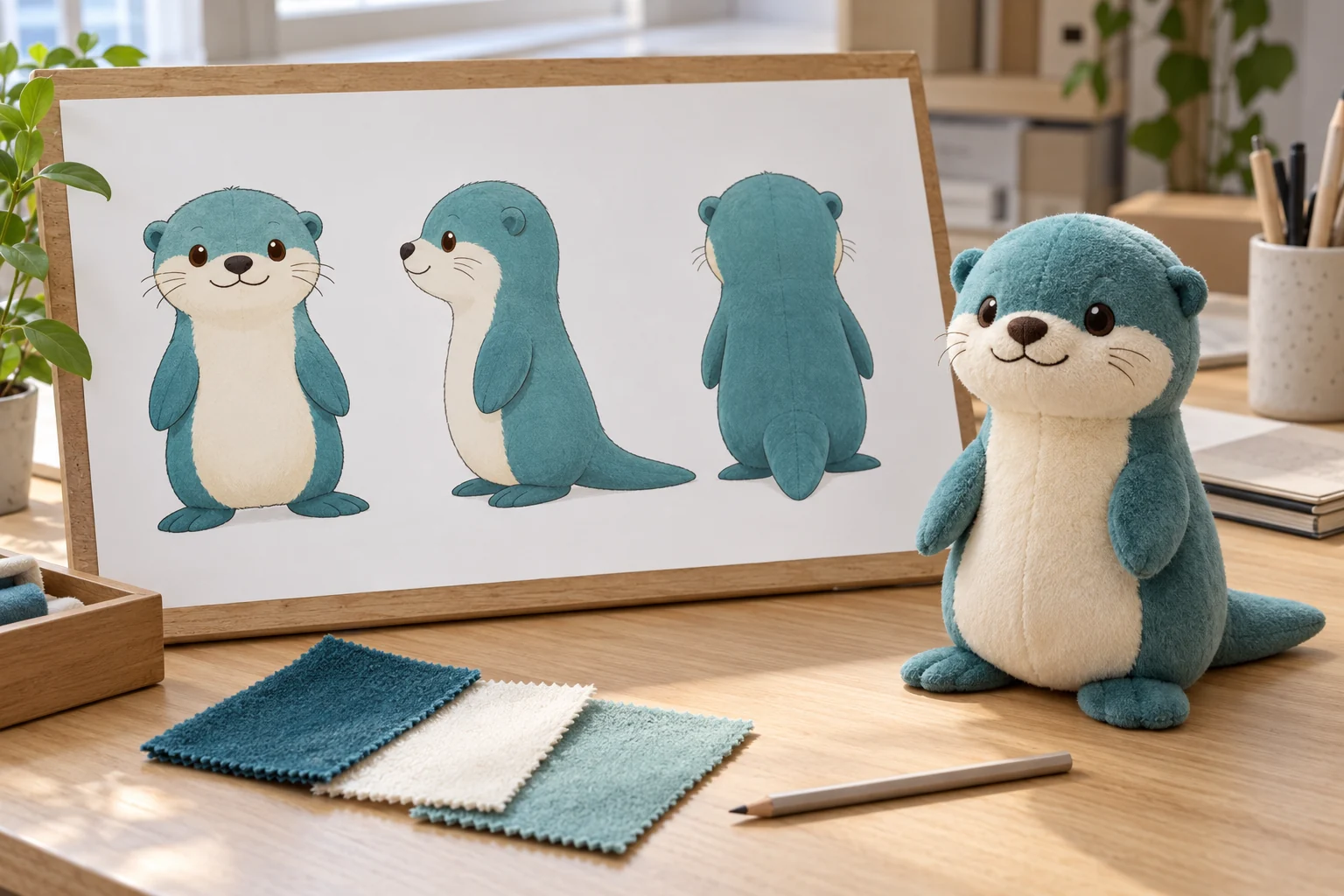
A cover illustration, an early sketch and a later story page may show different proportions or expressions. Select the controlling edition and provide front, side and back references where available. If the back is never illustrated, identify it as a design decision rather than asking the pattern maker to guess silently.
Mark the few features that readers must recognize: an asymmetric ear, a long muzzle, a particular eye shape or the relationship between the head and body. Distinguish them from details that may be simplified for a sewn product. A painted texture might become a printed fabric detail; fine facial marks might need a clearer embroidered interpretation. Ask for the proposed adaptation before approving it.
Specify the pose and measurement method. “Twenty centimetres” needs to say whether it means standing height, seated height or total length, and whether ears or another projecting feature are included. Keep a reference image beside the measurement description. If the first sample changes posture, revisit the dimensions rather than accepting the same nominal size automatically.
Separate the first sample from the eventual merchandise range
Write an included-and-excluded list for the development order. A body-only sample can settle the face and proportions without settling a removable outfit, gift box or electronic feature. The quotation and approval record should make that boundary clear.
- Character body: pose, size definition, fabrics, filling approach, colors and facial construction.
- Clothing and story objects: included or excluded; fixed or removable; which version the sample must show.
- Additional functions: any sound, light, recording, electronic or other feature requiring separate feasibility review.
- Printed components: labels, hang tags, credits, book-cover artwork and packaging, with their own approval stage.
- Book supply and assembly: who prints or supplies the book, where stock is received, and whether the order includes combining it with the plush.
Do not treat an attractive rendering as approval of construction or packaging fit. Equally, a body sample should not be rejected for omitting an item that was explicitly excluded. If the scope changes, ask what must be resampled, requoted or rescheduled before continuing.
Give reviewers distinct decisions and one feedback channel
Name a coordinator who collects feedback from the author, illustrator, rights contact and buyer. Record who has final authority for appearance, merchandise permission, budget and product release. On a small self-published project, one person may hold several roles, but the decisions should still be separate.
Review the physical prototype against the chosen artwork, not against every drawing ever made of the character. Use consistent front, profile and back photographs. Identify the sample version and annotate the exact area being discussed. If texture, firmness or packaging fit has only been viewed on screen, leave those checks open until the relevant physical review.
A useful correction has three parts: the reference, the observed difference and the requested outcome. For example, an illustrative note could say: “Front reference B: lower the ear tips to match the reference angle; retain the approved eye spacing.” Avoid combining that with an unrelated new outfit request under a single “minor changes” label.
- Correction against the brief: identify the requirement the sample does not yet meet.
- New preference or scope: identify the changed requirement and request its cost and timing impact.
- Accepted difference: record the adaptation that authorized reviewers agree to keep.
Ask the supplier how it classifies the changes under the agreed sample terms; the labels above do not decide who pays. After a change, recheck connected features. A larger head may alter balance and box fit, while a new collar may obscure the mouth. The custom plush sample guide covers the broader sampling workflow.
Plan the book and plush quantities separately
Decide whether readers will buy a standalone toy, a book-and-toy set, or both. List each character design and its quantity, then allocate that stock to offers and channels. A print run is a separate purchasing decision from the plush order.
Aokuma’s general minimum is 500 pieces per design. Two different characters at 250 pieces each do not automatically meet that minimum. If the same unchanged toy accompanies several language editions, list those book quantities separately and confirm whether labels, packaging or other differences change the manufacturing scope.
As a hypothetical stock plan, a buyer might allocate 500 purchased toys as 350 book bundles, 120 standalone toys and 30 retained units for agreed review or promotional purposes. That is an allocation of the order, not additional free stock. The bundle allocation needs the matching books and packaging; record who buys and holds any spares.
Budget beyond the toy unit price. Confirm sample development, courier, applicable testing, packaging, book supply, assembly, freight and any agreed licensing charges separately. Use the custom plush quotation checklist to compare the same scope rather than selecting the lowest incomplete figure.
Check the actual book-and-plush bundle before fixing its pack
The book introduces rigid edges and a separate thickness into the set. Give the pack designer the finished book width, height and spine thickness, plus any jacket or sleeve. Use the intended edition: a paperback substitute will not verify the fit of a thicker board book.
For the plush, record the widest points in the proposed packing position, including ears, clothing and attached objects. Confirm whether the book sits beside, below or behind the toy. Ask for the finished usable internal space of the package, then keep its closed outer dimensions separately for storage and shipping planning.
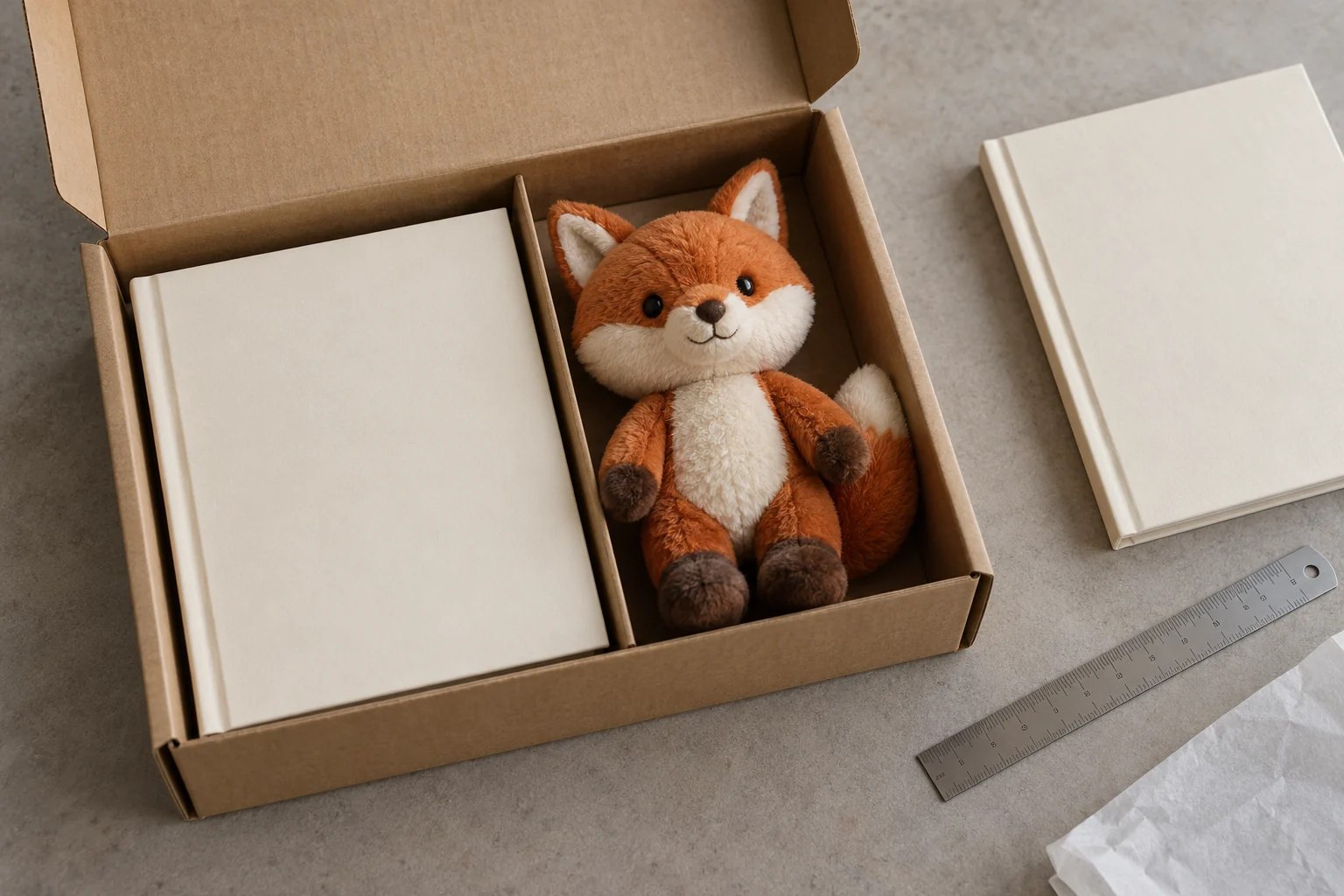
Review one assembled set with the current plush sample and the correct book or an agreed dimensionally representative dummy. Follow the intended packing sequence and check these points:
- The book goes in and comes out without catching the toy, clothing or tag attachment.
- Its corners and spine do not leave the character visibly distorted in the proposed arrangement.
- The package closes normally, without forcing the lid or relying on unapproved compression.
- The character’s face, book cover and required information are presented as intended.
- After unpacking, inspect both components for visible marking, creasing or other changes under the agreed review conditions.
Record photographs, component versions and the packing sequence. Any storage or transport assessment should be separately agreed for the actual route and package; this basic fit review does not establish transit performance. If the book format, plush size or insert changes, reopen the assembled-set check. The packaging approval checklist explains the component-level records in more detail.
Keep compliance and launch authorization separate from artwork approval
Provide the intended age group, sales destinations and relevant product features early. Ask the responsible compliance specialist to identify the assessment, testing, labeling and documentation required for the actual toy and its market. A soft fabric or embroidered face alone does not establish finished-product safety.
The CPSC’s toy safety business guidance explains U.S. requirements and the need to identify applicable provisions for a particular product. For EU destinations, consult the European Commission’s toy safety guidance, including the applicable legislation and transition dates. These resources support planning; they do not replace a project-specific compliance review.
Assign an owner to accept the required evidence and another, if necessary, to release stock for sale. Approval of the character’s expression, a supplier’s management-system certificate and approval to launch are different records. Check the final product and packaging versions covered by the evidence, especially after a material or accessory change.
Build the launch calendar around usable stock
Start with the date the completed sets must be received, checked and available at the fulfillment location. Include time for the book and plush to arrive separately, if applicable, and for assembly, counting and booking stock into the receiving system.
Aokuma’s standard sample fee is USD 200 per design, including up to three revision rounds. Standard sample development is 7–10 working days; the sample fee is refundable at a 3,000-piece bulk order of the same design. Courier and testing costs are separate, and special cases are individually quoted. Confirm the start conditions and refund arrangements in the quotation. Review, revisions and sample transport need their own timing; these terms are not a bulk-delivery promise.
Set dated decisions for development authorization, character approval, order release and launch readiness. Ask for project-specific production and freight timing after the scope is clear. If an approval slips, decide whether the book can launch alone or the bundle date needs to move before making availability claims. Use the sample-to-warehouse planning guide for the complete calendar.
Send a brief that supports a useful quotation
Contact Aokuma about a book-character plush project with the following information. Mark unknown items as undecided rather than filling them with assumptions:
- Approved character references, edition and artwork version; permission status and authorized reviewer.
- Target pose, size and measurement method; essential recognition features.
- Quantity per design, intended age group, sales countries and product functions.
- Included clothing, objects and printed components, plus explicit exclusions.
- Standalone or bundled offer; book dimensions, assembly location and packaging requirements.
- Required usable-stock date, delivery destination and the person coordinating approvals.
Keep the accepted brief, final sample reference and assembled-pack record together. They give the purchase team a clear handoff and help a future reorder start from the approved product instead of reopening every design decision.
