
Our Plush Toy Factory in Dongguan, China
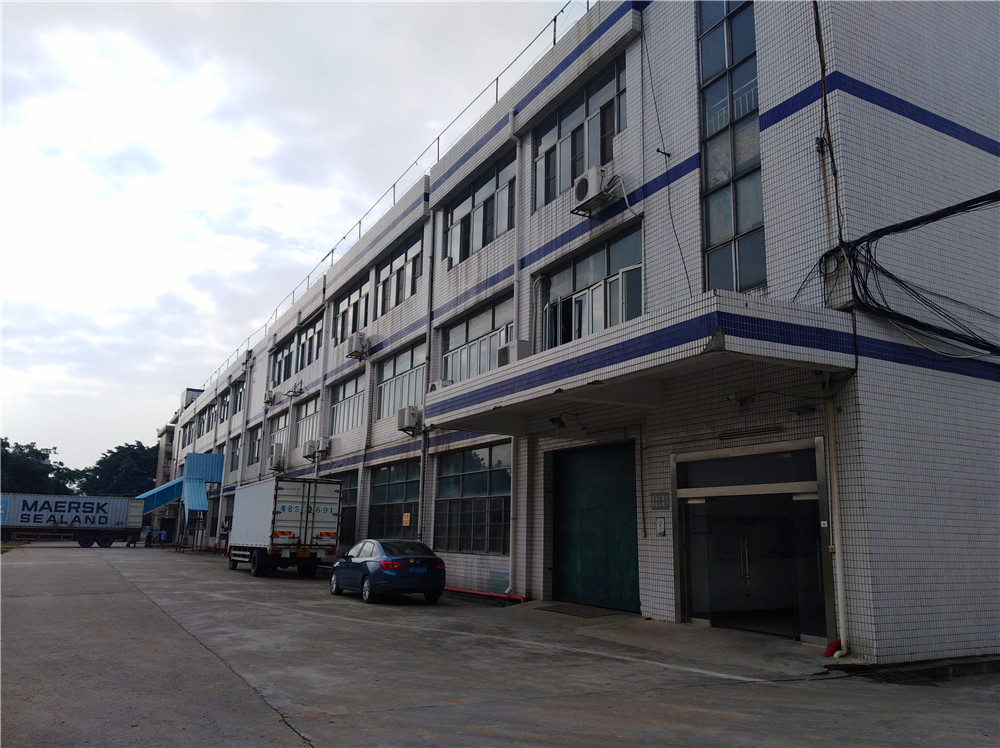
Every custom plush toy we ship is cut, sewn, embroidered, stuffed, inspected and packed in our own factory in Dongguan — the city that makes more stuffed animals than anywhere else on earth. This page is written for buyers doing due diligence: what the factory looks like, how quality is controlled, which audits we pass, and how to come and see it for yourself.
2014
Year founded
500 pcs
Minimum order per design
7–10 days
Physical sample, 2–3 revisions included
40–45 days
Standard production · rush 20–25 days
Where Your Plush Toys Are Made
Aokuma Toy was founded in 2014 and operates from Dongguan, Guangdong Province, in the middle of the Pearl River Delta plush supply chain. Being here matters: fabric mills, filling suppliers, embroidery-thread and accessory vendors are all within a short drive. That is why we can move from an approved sample to bulk production quickly, why samples take 7–10 days rather than weeks, and why we can hold a 500-piece minimum without cutting corners on materials.
Shenzhen and Guangzhou ports are one to two hours away for sea freight; Hong Kong and Guangzhou airports handle air and express shipments.
Design is a two-country effort. Pattern makers and the sample room sit inside the factory, while our design team works between China and the Philippines — which is how sketches, brand guidelines and character sheets from Western and Asian clients get translated into plush that reads correctly in both markets. Curious about the wider industry? Read our guide to where most stuffed animals are made.

Six Departments Under One Roof
Nothing is subcontracted. Each stage below is staffed by our own people, and each hands its work to the next with a count and a check.

1. Design & Pattern Making
Client artwork becomes a 3D pattern here. Designers and pattern makers work out proportions, seam placement, embroidery files and Pantone-matched fabric picks, then build the first physical sample. Every bulk unit is later checked against this approved sample.
2. Cutting
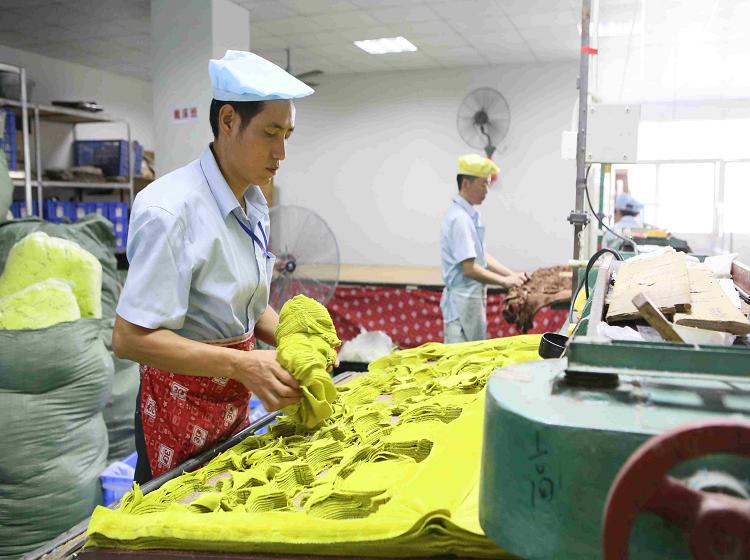
Plush fabric is layered and cut to the pattern with die-cutting for repeatable pieces. Cut panels are counted and bundled per unit so nothing gets mismatched on the sewing line.

3. Sewing & Assembly
Industrial machines handle structural seams; hand-sewing closes openings, attaches ears, tails and accessories and finishes details a machine cannot reach. This is the largest department on the floor.

4. Embroidery
Multi-head computerised embroidery machines stitch faces, logos and text. Embroidered features are our standard for anything intended for children under three, because there are no small parts to detach.

5. Stuffing & Shaping
PP cotton fill is blown in with pneumatic stuffing machines and shaped by hand so heads, limbs and bodies reach the firmness of the approved sample. Weight per unit is checked against the standard.
6. Finishing, Inspection & Packing
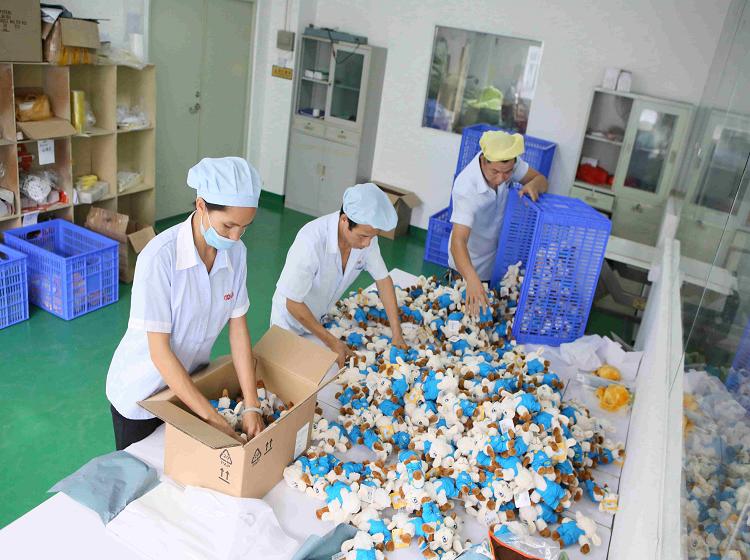
Grooming, hang-tag and label attachment, final visual inspection, polybagging and cartoning. Retail-ready packaging — header cards, gift boxes, PDQ displays — is assembled here as well.
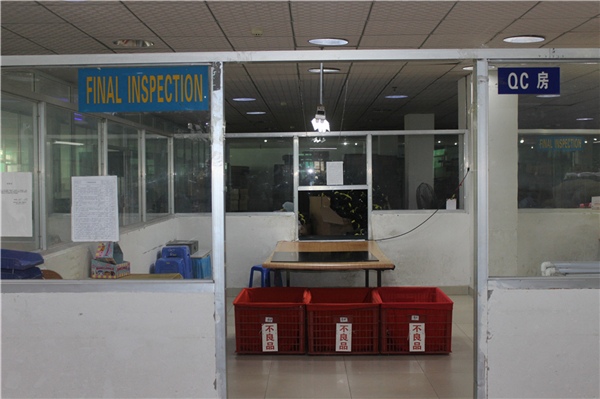
Quality Control: Four Metal-Detection Checkpoints, 20+ Inspectors
Safety failures in plush are almost always physical — a broken needle tip, a loose eye, a weak seam. Our QC is built around exactly those risks.
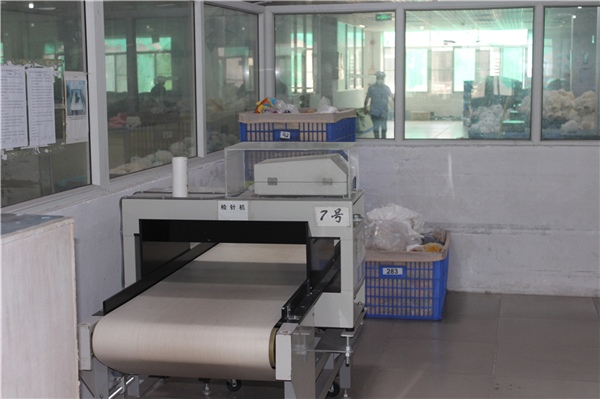
- Metal detection ×4 — after sewing, after stuffing, at final inspection and again before cartons are sealed. A unit that triggers the detector is opened, not just re-scanned.
- A dedicated QC team of 20+ inspectors, reporting separately from production, checks incoming fabric (colour, weight, pile), in-line workmanship and finished units against the approved sample.
- Pull tests on eyes, noses and accessories, seam-strength tests and stuffing-weight checks on every batch.
- AQL final inspection before shipment, with photos and a report sent to you. Third-party inspections (SGS, BV, Intertek, TÜV) are welcome at any stage.
For the standards behind these checks, see our article on plush toy safety standards.
Certifications and Audits
These are the documents retailers and licensors ask for before they will onboard a plush supplier. Copies are available on request.
Factory audits & management systems
- BSCI (amfori) social compliance audit
- ICTI Ethical Toy Program
- Sedex / SMETA and SCAN supply-chain security audit
- EcoVadis sustainability rating
- ISO 9001 quality management system
- GRS — Global Recycled Standard, for recycled-fibre plush
- Disney FAMA and NBCUniversal factory approvals for licensed products
- Walmart FCCA & WCA factory audits; registered supplier IDs with Target and Walmart
Product testing per market
- EN71 parts 1–3 (EU) and CE marking
- UKCA (United Kingdom)
- ASTM F963 and CPSIA (United States)
- REACH chemical compliance
- Age grading and labelling to your market's rules, including 0+ / under-3 designs
- Test reports issued by accredited third-party laboratories for each order


Client partnerships


People and Ethical Manufacturing
BSCI and ICTI audits check what we do every day: wages paid in full and on time, legal working hours with paid overtime, no child or forced labour, safe fire exits and guarded machinery, and freedom of association. Many of our sewers and pattern makers have been with us for more than a decade — experienced hands are the real reason bulk units match the sample.
Audit reports go to clients on request, and we accept client-commissioned audits at any time. Read more about the company on our About page.
Visit the Factory — In Person or by Video Call
In person. We are about 1.5 hours from Shenzhen Bao’an airport and 2 hours from Guangzhou Baiyun. Send us your dates and we will arrange pick-up and a walkthrough of every department, from the pattern room to the loading bay.
Virtual. A live video tour over Zoom, WhatsApp or Teams at a time that suits your time zone, so you can ask questions on the production floor. Existing clients also receive photos and short videos of their own orders at each milestone — cutting, sewing, stuffing, final inspection and loading.
How an Order Moves Through the Factory
The same six steps for a 500-piece pilot and a 50,000-piece programme — only the calendar changes.
Brief & quote (1–3 days)
Send artwork, a sketch or reference photos plus size, quantity and target market. We come back with a quotation, material suggestions and anything we would change for safety or cost.
Sample (7–10 days)
A physical sample with 2–3 rounds of revisions. Sampling costs US$150–300 per design and is refunded on orders of 3,000 pieces or more.
Approval & deposit
You sign off the sample and confirm quantity (from 500 pieces per design). A 30% deposit starts fabric and accessory purchasing.
Bulk production (40–45 days)
Cutting, sewing, embroidery, stuffing and finishing with in-line QC at every hand-over. Rush production in 20–25 days is possible when the schedule allows.
Final inspection & packing
AQL inspection, the last metal-detection pass, photos and report. The 70% balance is due before shipment.
Shipping
Sea freight typically 20–30 days to most destinations; air or express for urgent lots. FOB, CIF or door-to-door — see our lead-time guide.
Factory FAQ
Can I visit your factory in person?
Yes. We welcome client visits to our Dongguan facility and can arrange airport pick-up from Shenzhen or Guangzhou. If you cannot travel, we run live video tours over Zoom, WhatsApp or Teams and send production photos and videos of your own order at each milestone.
Has the factory passed third-party audits?
Yes. The factory holds BSCI, ICTI, Sedex/SMETA, SCAN and EcoVadis audits, ISO 9001 and GRS certification, Disney FAMA and NBCUniversal approvals, Walmart FCCA & WCA audits, and registered supplier IDs with Target and Walmart. Reports and certificates are shared with clients on request, and client-commissioned audits are welcome.
What is your minimum order quantity?
500 pieces per design. That is lower than most plush factories in China, which usually start at 1,000 pieces, and it lets brands, schools, nonprofits and start-ups run a pilot before scaling. Read our MOQ guide for how quantity affects price.
How do you protect our designs and intellectual property?
Every project starts with an NDA. Design files are stored with restricted access, production runs are kept separate by client, and we do not show one client’s designs to another. For licensed characters we manufacture only for the rights holder or an authorised licensee, and can provide the production documentation licensors require.
How fast can you make a sample, and what does it cost?
A physical sample takes 7–10 days from confirmed artwork and includes 2–3 rounds of revisions. Sampling costs US$150–300 per design depending on size and complexity, and the fee is refunded on orders of 3,000 pieces or more.
What are your lead times and payment terms?
Standard bulk production is 40–45 days after sample approval, or 20–25 days on a rush schedule when capacity allows. Sea freight adds roughly 20–30 days to most destinations; air and express are available. Payment is a 30% deposit with the 70% balance before shipment.
Can you make plush for children under three?
Yes. For 0+ products we use embroidered eyes and features instead of plastic parts, lock-stitched seams and tested fillings, and we test to EN71, ASTM F963 and CPSIA for the relevant age grade. Tell us the age grade at the briefing stage so the design is engineered for it from the start.
Further Reading About Our Manufacturing
Partner with a Certified Plush Toy Factory
Whether you are a brand comparing manufacturers, an importer verifying a factory in China, or a first-time buyer with a sketch, send us your project and we will reply within one business day.