
1. Define the Valentine offer before choosing the plush
Source Valentine’s plush toys around the offer the customer will actually buy: a standalone gift, a florist’s bouquet add-on, a two-piece gift set, or a branded campaign item. Record the quantity per design, the finished pack and the date that usable stock must reach each selling location. A low factory price does not rescue an assortment that arrives after its useful selling window.
This guide focuses on Valentine-specific decisions: gift-message versions, paired sets, bouquet and gift-box fit, store allocations, and the last date a replenishment can still be sold. For planning across several holidays, use the seasonal assortment guide. For the detailed sample-to-delivery stages, use the custom plush lead-time guide.
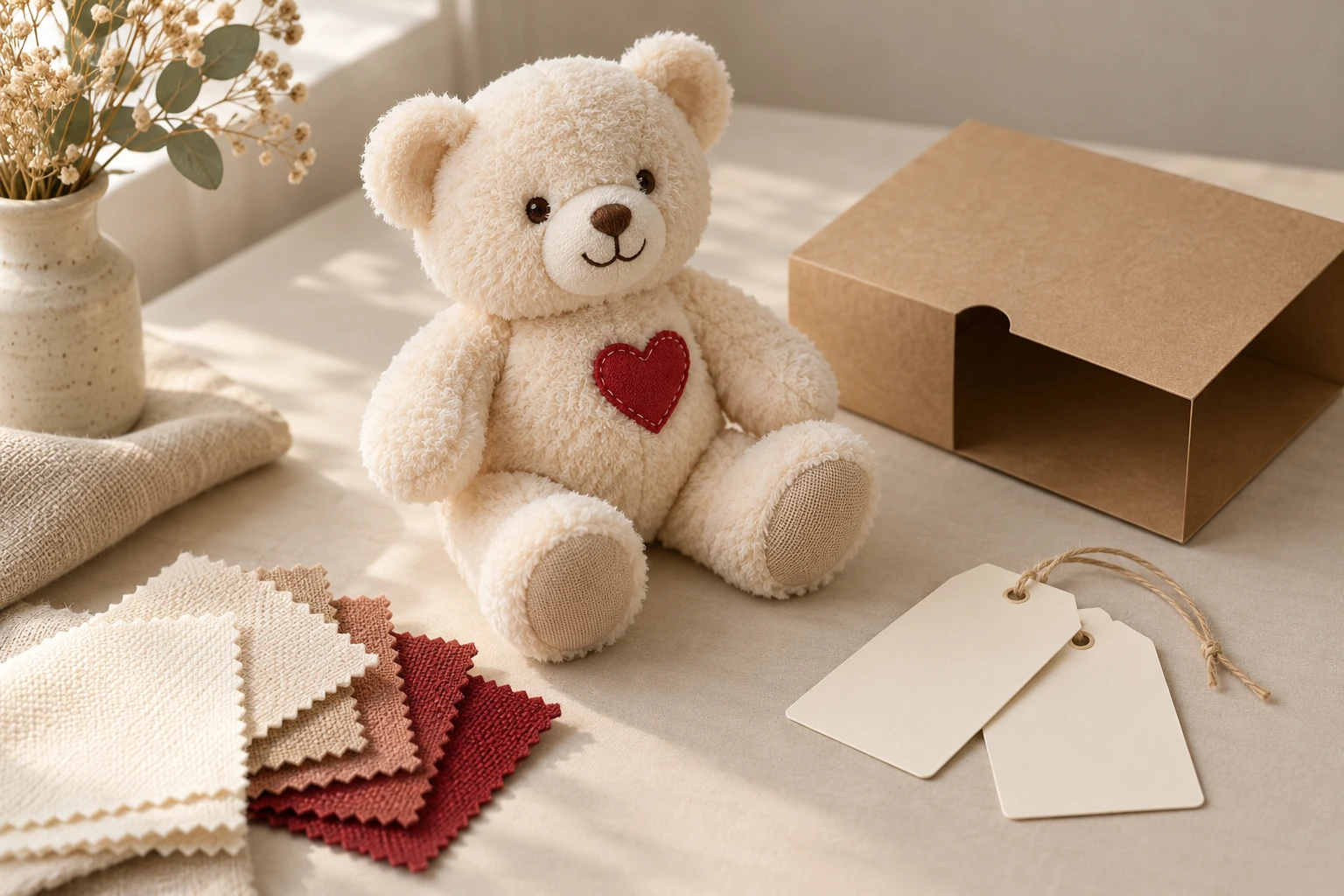
Write a one-sentence offer first. For example: “An undated bear holding a sewn heart, sold with our Valentine bouquet in one gift sleeve.” This is an illustrative brief, not an available stock product. It immediately raises useful questions: Does the bear fit beside the bouquet? Can staff assemble the combination quickly? Does the sleeve obscure the face or required information? Who supplies the other components?
Aokuma develops custom B2B plush orders rather than individual consumer gifts. Our website minimum is 500 pieces per design. List proposed sizes, colors, outfits and message versions separately; whether quantities can be combined must be confirmed in the written quotation. Do not divide a collection total among unrelated characters and assume the minimum is met.
2. Allocate stock by offer and selling location
Use evidence from your own comparable products, confirmed store requests or recipient commitments. Broad holiday-spending figures do not establish demand for your particular bear, price point or sales channel. Keep a working forecast and a lower-demand case, then decide how much residual stock the business can realistically handle.
Make one allocation row for every design and message version. Record its internal item code, sales channel, quantity, display use, destination and responsible buyer. Keep the total order quantity separate from the number of saleable gift sets.
A paired-set check
Suppose an illustrative offer contains one cream bear and one pink bear. Ordering 500 of each makes at most 500 complete pairs before any units are reserved for samples, displays or agreed replacements. It does not make 1,000 pairs. Confirm whether each bear is also sold separately, how a missing partner will be handled, and whether the two designs must ship together. This arithmetic example is not a recommended assortment or a demand forecast.
For a florist add-on, distinguish units allocated to participating branches from units held at a central warehouse. A total that looks sufficient centrally can still leave individual stores without stock when transfer time is overlooked. Ask the receiving team whether cartons should be separated by design, message or destination. Any special packing or allocation work needs explicit scope and pricing.
3. Approve the love message as part of the physical product
“Love,” “Be mine,” a company logo and an individual recipient name are different production requests. Decide whether the whole batch repeats one design, a collection contains several fixed messages, or every unit needs unique text. Individual-name work should not be assumed to be included in a standard custom order.
- Wording: approved spelling, punctuation, language and capitalization, with one final artwork reference.
- Placement: body, sewn heart, clothing, hang tag or outer pack. Identify which surface must face the customer.
- Legibility: inspect the actual sample at the intended selling distance. A clear flat file can become hard to read on a curved heart or folded ribbon.
- Version control: assign a distinct code and quantity to each message. Check the code on artwork, packing instructions and the order list.
- Approval owner: name who can release the wording and any licensed artwork. Use only designs and marks you are authorized to reproduce.
If the product will be photographed before bulk approval, track whether later changes affect the sales image. Do not show one message online while shipping another. For paired products, review both characters together so their wording, orientation and presentation make sense as a set.
Permanent Valentine wording can be appropriate when it defines the offer. If you want an undated product that can also serve birthdays or other gifts, consider carrying the campaign message on packaging instead. Check the actual repacking work, labels, approvals and costs before relying on that flexibility. A removable accessory is not automatically a safe or simple solution.
4. Test the gift combination, not only the loose plush
For a bouquet add-on, gift hamper or box set, approve the complete proposed arrangement. Measure the usable interior of the container and identify what else must fit. Include the plush’s widest point, projecting ears, heart, clothing and any attachment. A nominal seated height alone cannot prove that a lid will close or the gift will look balanced.
Ask for a packing mock-up or physical fit check using the agreed product version. Record whether the plush is presented seated, lying down or lightly compressed, and how it should recover after unpacking. Do not make an untested compression level a production requirement just to fit a smaller carton.
Give the supplier and the gift-assembly team the same responsibilities list: who provides the plush, box, sleeve, tag, barcode and other gift components; who assembles them; and who checks the finished combination. If flowers, chocolates or another item are supplied separately, do not assume the plush manufacturer has verified that item or the complete bundle.
Review the intended age group and destination-market requirements for the actual finished toy and accessories with the responsible compliance contact. Soft fabric or attractive stitching alone does not establish safety compliance. The U.S. CPSC toy-safety guidance is a starting point for U.S. requirements, not certification of this product. See our combined packaging approval checklist for the product-and-pack review.
5. Work backward from the last useful selling date
Do not use February 14 as the only deadline. A store display may open earlier, and an online seller needs time to receive, check and fulfill orders before its customer-delivery cutoff. Use your actual market and fulfillment plan rather than a universal “order by” date.
- Set the first day the Valentine offer must be available.
- Set the date counted, inspected and allocated stock must be ready at each location.
- Record the receiving appointment or delivery constraints at the warehouse.
- Ask the supplier to assess sampling, approval, testing where applicable, production, inspection and shipment against those dates.
- Set the last date at which a reduced quantity or alternative plan would still be useful.
Keep factory completion, carrier departure, port arrival, warehouse receipt and retail readiness separate. A shipment milestone is not a promise that the goods are ready for sale. Use the confirmed specification, packing dimensions, destination and transport plan when obtaining a schedule.
Aokuma’s indicative standard sample fee is USD 150–200 per design, subject to design review; complex work is quoted separately. Typical sample making is 7–10 working days, subject to written project confirmation. Review, revision and shipping time need their own allowance. Sample-fee refund eligibility at an order of at least 3,000 pieces of the same design follows the agreed quotation. These planning references are not a Valentine delivery guarantee.
If a deadline becomes doubtful, ask what can actually be completed and released, not merely whether faster transport exists. An air-first, sea-later plan only helps if the first allocation still reaches its intended selling location in useful time. Do not waive required safety or quality checks to protect a marketing date.
6. Compare the total gift-offer cost and replenishment decision
Request the same specification and delivery scope in every comparison. Separate the plush price from sampling, agreed testing, gift packaging, assembly, special carton allocation and transport. Identify charges that apply once, per design, per order or per unit. The production-cost guide explains the design choices behind factory cost.
For your internal gift-set budget, include components and work sourced elsewhere too. A quote for the bear alone cannot be compared directly with a quote for a packed pair with a sleeve. If a component is excluded, record who will procure it and whether its arrival controls the entire offer.
Use a replenishment gate
Before a repeat order, check actual remaining stock and sales rate by design, the last useful receipt date, the revised production and transport estimate, and the quantity still justified. A design selling quickly early in the campaign does not automatically support another minimum order when most of the selling window will have passed.
Ask whether approved materials, artwork and packaging can be repeated, and whether anything must be resampled or reverified. A previous successful order does not confirm current capacity, identical material availability or the same freight cost. Get any revised scope and commercial terms in writing before committing.
7. Send a quotation brief that exposes the unresolved decisions
Copy the fields below into your request. Mark unknowns clearly instead of filling them with assumptions.
- Offer: standalone plush, bouquet add-on, paired gift or another defined combination.
- Design references and permission to use the artwork; finished size and important fit limits.
- Quantity for each design, color, message and proposed size.
- Message artwork, decoration position and final approval contact.
- Intended age group, destination sales market and required product evidence.
- Gift packaging, component suppliers, assembly responsibilities and carton allocation.
- Delivery country and postal code, receiving constraints and preferred quotation scope.
- First selling date, required ready-to-use date and latest useful receipt date.
- Whether a partial first allocation would still serve the campaign.
Send your Valentine plush brief for a project review. We can assess the design and information provided, then clarify the quotation and schedule. Confirm the actual sample, specification, costs and delivery plan before advertising a guaranteed launch.
What if the plan no longer fits the selling window?
Decide whether to reduce the proposed assortment before ordering, change the gift offer, move to a later suitable campaign or stop a new purchase. For an order already placed, check its agreed terms and work already committed before requesting changes. A missed internal marketing date does not by itself establish a cancellation or refund right.
Can all Valentine messages share one minimum?
Do not assume so. Supply the version list and quantities for review. The confirmed website minimum is 500 pieces per design; treatment of message, color and size variations is determined in the written quotation.
Further buying guides: Buying teddy bears in bulk · Choosing plush materials · Retail assortment planning · Custom plush for brands
