
Plush toy production cost depends on the specification, the work needed to make it, the quantity of each design, and the scope included in the quotation. To understand a factory price, separate recurring product costs from one-time development charges, order-level services and delivery costs. Then ask which design or specification change would alter each line. A generic percentage chart cannot tell you what your own plush should cost.
This guide is for brands, publishers, merchandise teams and other bulk buyers who want to understand the factory side of a quotation. It provides a cost-driver checklist and a line-item worksheet. For the wider budget through arrival at your warehouse, use our custom plush quotation and total-cost guide.
Preparing a brief? Send Aokuma your artwork, finished size and quantity per design, along with the destination and required arrival date. Mark undecided details so they can be reviewed rather than silently assumed.
What does a plush factory quotation actually include?
The unit price may cover a finished, individually packed toy, or it may cover only the toy with basic packaging. Development, custom packaging setup, testing, inspection and transport may be bundled or listed separately. Neither format is automatically better. The important question is whether every supplier has priced the same deliverable.
Ask for each charge to be assigned to one of four bases:
- Per design or development stage: prototype work, a new pattern, embroidery digitizing or another setup service, where charged separately.
- Per finished unit: the approved fabric, filling, construction, decoration, accessories and specified packaging.
- Per order, batch or service: a defined testing scope, inspection visit, packaging setup or another identified service.
- Per shipment: freight, documentation and handling within the agreed delivery scope.
These are questions for organizing a quote, not a claim that every factory charges all four categories separately. If a cost is already included in the unit price, mark it “included” and do not add it again. If it is unknown, leave it “to be confirmed”; a blank field should never become a zero in your budget.
Material cost starts with a usable specification
A fabric name alone is too broad for a like-for-like comparison. Two suppliers can both write “minky” while proposing different pile, backing, weight, stretch or color options. Ask for the actual proposed material reference and a swatch, and connect that reference to the sample version.
Fabric: compare the specification and consumption
Record where each material is used: body, muzzle, ears, feet, clothing and any contrasting panels. Ask the supplier to identify a stock color versus a custom color requirement and to explain any minimum material purchase that affects the quote. A custom fabric purchase minimum is a separate question from the finished-toy minimum.
The shape and panel layout also matter. Small protruding details, directional pile and many separate color panels can change cutting and sewing requirements. Request a review of the actual pattern concept rather than estimating consumption from the toy’s height alone. For a material-by-material brief, see our fabric and filling specification guide and minky fabric selection guide.
Filling: define the result you want
Describe the intended firmness, shape recovery and areas needing support. Request the proposed filling type and, where useful, the agreed finished weight or fill-weight basis. A photograph cannot establish how firm the toy feels. The physical sample should become the reference for an approved result.
A lighter filling proposal may lower one input but also change the silhouette, balance or feel. Treat it as a specification alternative requiring review, not an automatic saving. Weighted inserts, pellets or special fillings need their own feasibility and safety assessment; do not treat them as interchangeable with ordinary fiberfill.
Linings and hidden components still belong in the brief
Ask whether a lining, internal pocket, reinforcement or insert is included. These details are easy to miss when comparing a front-view drawing with a finished prototype. If a supplier proposes an internal component, record its purpose and material, and ask whether changing it affects construction, care instructions or testing.
Public commodity prices can provide background about a raw input. They do not establish the cost of purchasing, converting and using a particular plush material in your order. Avoid multiplying a market fiber price by the toy’s weight and treating the result as a factory’s true material bill.
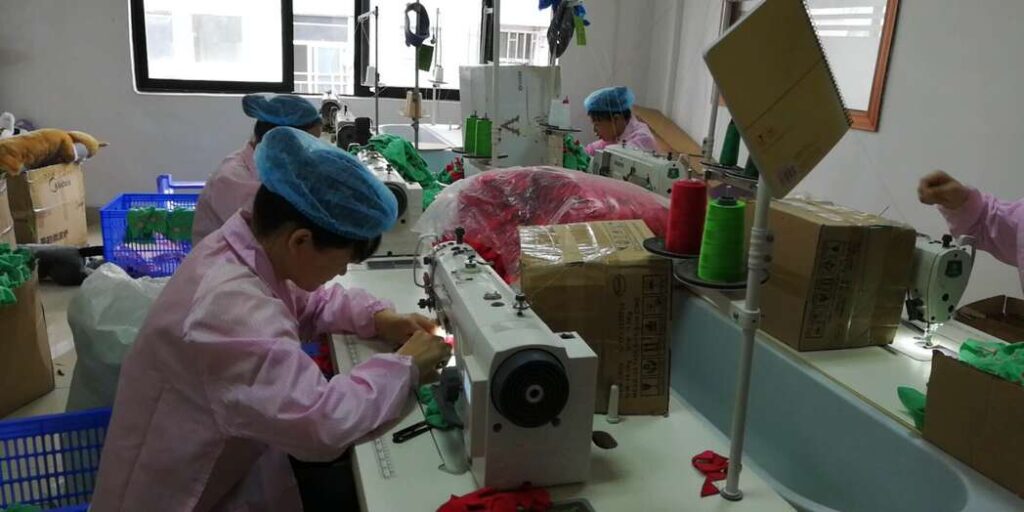
Which design details change the work required?
For a specific design, the useful question is “Which operations are driving this quotation?” Ask the supplier to identify the main contributors and price a controlled alternative. There is no dependable universal minutes-per-toy figure that applies to every character, size and construction.
- Panel and seam complexity: request feedback on narrow limbs, small curved pieces, unusual shapes and difficult closing points.
- Face decoration: compare the proposed embroidery, applique or printing method at the actual finished size. Include position, color and approved appearance.
- Clothing: specify separate or integrated clothing, printed or embroidered branding, fastening and whether the garment is removable.
- Attachments: identify the exact component, connection point and reinforcement proposal rather than writing only “keychain included.”
- Finishing: record any grooming, shaping, detail placement or special presentation expected in the approved sample.
Keep the character’s recognizable features in a “must retain” column. Put optional details in a second column. The supplier can then discuss a simpler construction without guessing which feature matters most to your audience. Any revised quote should name the changed specification and sample version.
For example, you might ask for two proposals with the same overall size and face: one with a separate jacket and one with an integrated clothing treatment. That is a useful comparison only after the visual differences and construction have been explained. It does not establish that either option is feasible or cheaper for your design.
Accessories and packaging need their own quantities
List sewn labels, hang tags, individual bags, gift boxes, inserts and master cartons separately in the brief. Ask which are included in the unit price and which have a setup or minimum purchase charge. Confirm whether the packing service itself is included.
A toy quantity and a printed-box purchase quantity may differ. If the packaging supplier requires more boxes than the first toy order needs, ask who owns the excess, where it will be stored, how storage is charged and what happens if the artwork changes. Do not assume leftover packaging will be free to store or usable indefinitely.
For an event, compare the handling requirements of individual bags and bulk packing. For retail merchandise, approve the plush and packaging as a matched version using the packaging approval checklist. Neither a packaging mock-up nor a low packaging price confirms that the final packed toy will fit or arrive as expected.
How should you discuss overhead and setup costs?
Factory operation involves equipment, facilities, supervision and other shared costs. A supplier may include these within its selling price rather than disclose them as separate lines. Buyers can ask what is included without assuming they are entitled to a factory’s internal accounting or that a missing overhead line means there is no overhead.
Published electricity tariffs, regional wage averages or equipment prices cannot by themselves reveal a factory’s actual overhead allocation. For procurement, it is more useful to establish which services the quoted price buys, what triggers an extra charge, and how a proposed specification change affects the revised offer.
Ask whether any setup charge applies again on a repeat order, and what happens if the artwork, fabric, color or packaging changes. Keep the answer in the quotation. A previous pattern or sample does not automatically establish a lower minimum, a waived sample fee or the same current price. Our reorder checklist covers the items to reconfirm.
Separate product inspection from safety testing
Write down the planned quality checks: what will be inspected, the approved reference, the defect definitions, the sampling approach and who will make the release decision. If a third-party inspection is requested, clarify the quoted scope, visit arrangements, reporting and responsibility for any follow-up inspection.
ISO 2859-1 describes acceptance sampling for inspection by attributes. It does not supply one universal “plush industry default” for every order, nor does an AQL number alone define the complete inspection plan. Have the relevant parties agree the standard and edition, inspection level, defect categories and decision rules. Do not interpret an AQL value as a guarantee of the exact defect percentage in a shipment.
Safety testing is a separate scope. For the United States, CPSC’s toy-safety guidance explains applicable testing and certification requirements for children’s toys, including the role of CPSC-accepted laboratories. Confirm the actual product, age group and destination with the relevant specialist before setting a testing budget.
Ask which samples and variants the laboratory quote covers, which requirements it addresses, who prepares the compliance documentation and whether a material or design change would require reassessment. A general factory audit or an old report for another product does not answer those questions. Use our safety-document guide for a fuller review checklist.
Use a line-item worksheet before negotiating
Copy the following structure for each offer. Add an “included,” “excluded” or “pending” status beside every line, and keep the same currency, design version and quantity basis throughout. Ask the supplier to correct your interpretation before relying on the total.
| Cost line | Quantity basis | What to confirm |
|---|---|---|
| Finished plush | Units per design and variant | Size, materials, decoration, accessories and approved version |
| Development/sample | Per design or agreed scope | Included revisions, extra work, shipping and any refund conditions |
| Packaging | Per unit plus any setup | Artwork version, packing labor, minimum purchase and excess stock |
| Testing and documentation | Defined product/variant scope | Lab quotation, applicable requirements and reassessment exclusions |
| Inspection | Agreed batch or visit | Criteria, reporting, travel and repeat-inspection responsibility |
| Delivery services | Per shipment | Named delivery point, agreed trade term and itemized exclusions |
A working total is: quoted unit price × ordered quantity, plus separately charged development, packaging, testing, inspection and delivery items. Subtract only a credit that is actually agreed for that order. This is a worksheet structure, not an Aokuma quotation.
A hypothetical comparison with one missing line
The following numbers are invented solely to illustrate the arithmetic; they are not market prices or an Aokuma offer. Assume two suppliers propose the same approved specification for 500 units. Offer A is USD 6.20 per toy plus USD 0.50 per unit for the required packaging. Offer B is USD 6.60 per packed toy.
- Offer A’s comparable packed-goods subtotal is 500 × (6.20 + 0.50) = USD 3,350.
- Offer B’s comparable packed-goods subtotal is 500 × 6.60 = USD 3,300.
- On that limited basis, B is USD 50 lower, even though its headline unit price is higher.
Neither subtotal includes development, testing, inspection or delivery in this example. Those must still be reconciled before a full comparison. If the materials, packaging or quality scope differ, stop the price comparison and resolve those differences first.
How quantity changes the comparison
Request quantity tiers using one unchanged specification, and show the quantity of every design and variant. An overall project total can hide several smaller production runs. Keep combined totals separate from each design’s quoted quantity.
Aokuma’s production minimum is 500 pieces per design. Our standard sample fee is USD 200 per design, including up to three revision rounds. Standard sampling takes 7–10 working days; confirm the start point, revision timing and sample delivery separately. The sample fee is refundable when the order reaches 3,000 units of the same design. Special cases are quoted and agreed separately; confirm shipping, testing and extra work in the offer.
The production minimum and sample-fee refund threshold serve different purposes. A 500-unit order does not by itself qualify for the 3,000-unit refund. See the MOQ and variant guide and sample approval guide before comparing quantity options.
Keep production location and delivery scope visible
A sourcing location is one input to supplier selection; it is not proof of a particular price, speed or quality. Ask which facility will perform the work and whether any stages are subcontracted. Match the quotation and production plan to that arrangement rather than assuming everything shown on a website happens at the named address.
ICC’s Incoterms® 2020 rules allocate specified delivery responsibilities, costs and risks between buyer and seller. Put the selected rule, named place or port and version in the quotation, and confirm exclusions. A factory-gate figure and a delivered figure are not directly comparable. Our EXW, FOB and DDP comparison helps organize that conversation.
Can you calculate a factory’s profit from its quotation?
You generally cannot establish the supplier’s actual margin from a selling price, a commodity index and a regional wage estimate. The factory may have different purchase terms, process efficiency, overhead allocation and commercial costs. Without verified accounting data, a published “normal margin” would be an assumption.
A more productive negotiation asks for the effect of a specific change: a different approved fabric, fewer optional details, an alternative packaging format or a different quantity per design. Request an updated written offer showing what changed. Preserve safety requirements and the agreed quality criteria throughout.
Frequently asked questions
Can I get a reliable production price from a drawing alone?
A drawing can start a discussion. A useful estimate also needs size, quantity per design, material expectations, decoration, accessories and packaging. Ask which assumptions remain provisional and when the price will be reconfirmed against the sample.
Can I compare factories by labor minutes per toy?
Only if the design, operation scope, measurement method and supporting data are comparable. For most buyers, evaluating the proposed construction and a controlled alternative is more useful than applying a generic labor-time estimate.
Does a lower material price mean a lower finished-toy price?
Not necessarily. Check whether the alternative changes consumption, cutting, sewing, appearance or approval work. Compare the complete revised specification, including any new development charge.
Must a supplier disclose its margin or full bill of costs?
That depends on the commercial arrangement. For a normal quotation, focus first on a clear finished-product specification, included services, exclusions, validity and change conditions. A detailed offer can be comparable without revealing confidential supplier accounting.
Turn the quotation into a set of clear decisions
Before accepting an offer, make sure every amount has a basis, every included item has a specification, and every unknown has an owner. Keep the quote, artwork, sample, packaging and inspection versions together. Confirm production and shipment milestones separately using the sample-to-delivery planning guide.
Request a custom plush quotation from Aokuma. Include the design files you are authorized to share, target size, quantity per design, packaging, destination and required arrival date. Tell us which features must stay and which alternatives you want evaluated, so the quotation can explain the choices that matter to your project.
