
Yes, custom plush orders can be routed to a buyer-appointed consolidation warehouse in China when the factory and warehouse agree on the delivery arrangements. Confirm the exact receiving address, warehouse reference, packing instructions, appointment process, and handover responsibilities before dispatch. A city name and a freight forwarder’s contact are useful starting points, but they are not a complete receiving instruction.
For plush buyers combining products from several suppliers, the practical goal is straightforward: the warehouse should identify your cartons, reconcile the shipment, record its condition, and connect it to the correct onward booking. This guide covers that factory-to-warehouse handover, including orders with custom gift boxes, fabric bags, and hangtags.
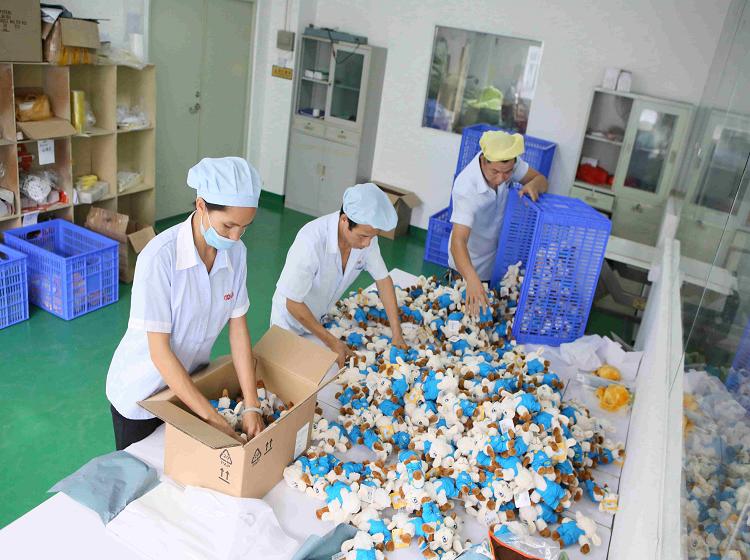
1. Separate warehouse receiving from the onward export shipment
Treat the movement as two connected stages. First, the factory prepares and sends the agreed goods to the nominated Chinese warehouse. Second, the party responsible for onward logistics consolidates, books, documents, and arranges the international shipment.
Ask your forwarder to confirm which services its warehouse actually provides. Receiving cartons, counting individual units, inspecting products, assembling gift sets, repacking, storing goods, and preparing export documents are different tasks. Include any required service in the written scope rather than assuming it comes with storage.
A warehouse receipt records the receipt described on that document. By itself, it does not establish that export or import clearance is complete, that a sailing is booked, or that the goods have passed product inspection.
This guide assumes an ordinary domestic receiving arrangement. If the nominated site is bonded or otherwise customs-supervised, have your forwarder confirm its entry procedures and documentation before the factory dispatches anything. The warehouse’s own current instructions should govern the receiving process.
2. Get one complete receiving instruction
Ask the forwarder or warehouse to issue a single instruction that the buyer, factory, and domestic carrier can all use. Confirm the version before printing labels or booking transport. The following is a practical checklist; individual warehouses may request different information.
- Receiving company and site: the warehouse’s full name, complete Chinese address, building or gate details, and receiving contact.
- Buyer identification: your warehouse account code, customer reference, and any inbound booking or shipment number.
- Cargo scope: purchase order, product codes, expected carton count, and whether packaging materials arrive separately.
- Delivery access: receiving hours, appointment requirements, vehicle restrictions, unloading arrangements, and any documents the driver must present.
- Packing rules: carton limits, pallet requirements if applicable, label format, barcode specifications, and label placement.
- Acceptance process: what the warehouse checks, what receipt it issues, and whom it contacts about discrepancies.
- Exceptions: instructions for late vehicles, damaged cartons, missing references, and deliveries the warehouse cannot accept.
Verify changes through the established warehouse or forwarder contact, especially a last-minute address change. Keep the factory’s dispatch contact and the warehouse’s receiving contact on the same email thread so operational questions reach the right person.
3. Approve the packed plush configuration before bulk packing
A plush sample approval should be accompanied by a clear packaging decision. A gift box, fabric bag, or hangtag changes how each unit is prepared and how the receiver can verify it.
Gift boxes
Specify whether the plush arrives inside an assembled box or whether flat boxes travel separately. Approve the fit, internal protection, box orientation, and the number of finished sets per master carton. Ask for photos showing the closed retail pack and the arrangement inside the shipping carton.
Fabric bags and hangtags
Confirm whether the fabric bag is the individual presentation pack, an additional accessory, or a separately packed item. Approve the hangtag artwork version, attachment position, and protection against bending or rubbing. Give loose accessories their own product codes and packing-list lines.
Compression and repacking
Do not approve compression solely from an estimated carton saving. Evaluate a packed sample for your particular plush shape, fabric, accessories, and retail presentation. Record the accepted packing method and tell the warehouse whether it may open, compress, or repack the goods. Any approved repacking should preserve product identification and required labels.
For the development stage, see Aokuma’s custom plush sampling guide. Aokuma’s standard MOQ is 500 pieces per design. The standard sample fee is USD 200 per design, with a maximum of three revision rounds; it is refunded against an order of 3,000 units of the same design. Standard sampling takes 7–10 working days, with exceptions quoted separately. Confirm the scope of any packaging samples in your project quotation.
4. Make carton marks and the packing list tell the same story
The warehouse needs to connect a physical carton to your account and to a specific packing-list entry. Ask it to approve a label proof before the factory prints the full set.
Useful carton-mark fields include:
- Warehouse customer code and inbound booking reference
- Purchase order and product or SKU code
- Carton number within the shipment
- Quantity and unit of measure, such as individual plush pieces or complete gift sets
- Gross weight, carton dimensions, and handling information requested by the warehouse
Use the receiver’s required barcode and layout where specified. Do not invent a warehouse reference or substitute the factory’s order number for it. Keep old shipping labels from creating competing instructions on reused outer packaging.
The packing list should identify the contents of each carton or clearly defined carton range. Show different plush designs, sizes, packaging configurations, and separately packed accessories on distinguishable lines. Identify any partial carton instead of describing every carton as having the same quantity.
The U.S. International Trade Administration’s export-document guidance describes common packing-list information such as quantities, package counts, weights, marks, and dimensions, and recommends consistency with the commercial invoice. This is useful document practice, not a substitute for your Chinese forwarder’s shipment-specific instructions.
Before dispatch, reconcile three totals: ordered units approved for shipment, units on the final packing list, and units represented by the actual packed cartons. Distinguish packed accessories from complete retail sets to avoid double-counting. Share the final version with the warehouse and replace superseded drafts.
5. Book domestic delivery against confirmed receiving arrangements
Send an advance delivery notice containing the reference, expected arrival window, carton count, final packing list, and available carrier details. Ask the warehouse to confirm that the reference is active and the shipment can be received.
Confirm who books the vehicle and who handles unloading. If an appointment, pallet exchange, special vehicle, or driver registration is required, resolve it before loading. Agree who can approve waiting, redelivery, relabeling, or other additional work if the receiving plan changes.
Keep factory readiness, warehouse acceptance, and the forwarder’s cargo cutoff as separate milestones. Ask the forwarder how much receiving and discrepancy-resolution time it needs before the onward booking closes. Dispatching on the cutoff date may leave no practical opportunity to correct a rejected label or carton-count mismatch.
Before the truck departs, retain photos of representative packed cartons, readable marks, and the loaded shipment where feasible. Photos support the handover record; they do not replace an agreed inspection or establish the condition of every item inside sealed cartons.
6. Define what the warehouse will check and record
Agree the receiving check in advance. A count of sealed master cartons is a different service from opening cartons and counting every plush toy. Specify whether acceptance includes label scanning, gross-weight checks, retail-pack inspection, or a separate quality inspection.
Request a receipt that identifies the receiving site, arrival date, inbound reference, carton count accepted, and recorded exceptions. Where your booking requires it, ask for the receiver’s signature, stamp, or system confirmation.
If the warehouse finds damage or a shortage, ask it to:
- Identify the affected carton numbers and describe the visible issue precisely.
- Photograph the label, overall carton, damaged area, and affected contents if opened under the agreed procedure.
- Record the exception on the delivery or receiving record, following the carrier’s process.
- Separate affected goods where practical and preserve relevant packaging while instructions are obtained.
- Notify the designated buyer, factory, and logistics contacts promptly.
As a carrier-specific example, DHL Freight’s claims guidance for Sweden emphasizes recording visible damage at delivery and supporting damage reports with photographs. Its procedures and deadlines are specific to that service. Obtain the applicable reporting requirements from your actual Chinese carrier and warehouse.
Agree who can authorize opening, repairs, repacking, returns, or onward release. Avoid sending affected cartons into consolidation before the responsible parties decide how the discrepancy should be handled. A receipt showing intact outer cartons cannot establish that every plush unit meets the approved specification.
7. Put handover responsibilities in writing
Use a short responsibility schedule alongside the order and logistics instructions. Assign a named party to each task:
- Final packing and carton labeling
- Domestic transport booking and payment
- Appointment confirmation, unloading, and receiving charges
- Discrepancy reporting and decisions about affected goods
- Storage, consolidation, and authorization for any repacking
- Export documentation and customs coordination
- International transport, insurance arrangements, and destination import work
Keep the agreed risk-transfer point explicit in the sales contract. The fact that a factory pays for a domestic truck, or that a warehouse signs a receipt, is not enough on its own to determine the contractual allocation of risk. ICC Academy’s guidance on delivery and risk transfer explains why the precise delivery point and selected contractual terms matter.
If you use an Incoterms® rule, specify the rule, named place or point, and version, and have the parties check that the operational plan fits it. For the separate question of comparing quotations, read Aokuma’s custom plush EXW, FOB, and DDP quote comparison. A warehouse receiving instruction should complement the agreed terms.
8. Copy this warehouse-delivery RFQ template
Send the following information with your plush specification. Leave unknown fields marked “to be confirmed” and identify who will supply them.
Subject: Custom plush quotation with delivery to our China consolidation warehouse
Please quote our custom plush project and confirm whether you can arrange domestic delivery to the warehouse below.
- Product: [design reference, finished size, materials, quantity per design]
- Retail packing: [gift box / fabric bag / hangtag; assembled or supplied separately]
- Warehouse: [company, full Chinese address, receiving contact]
- Our references: [warehouse account code, purchase order, inbound booking reference]
- Receiving requirements: [attach current label, packing, appointment, unloading, and vehicle instructions]
- Requested arrival window: [warehouse receiving window and forwarder cutoff, if confirmed]
- Documents: [carton-level packing list and other documents requested by our forwarder]
- Delivery scope: [who arranges transport, unloading, and receipt collection]
- Acceptance: [carton count / unit count / separately agreed inspection]
- Exceptions contact: [person authorized to decide on damage, shortages, or rejected delivery]
- Onward shipment: [forwarder and parties responsible for export and destination procedures]
Please identify the proposed packing configuration, domestic delivery inclusions and exclusions, information still needed, and any separately quoted services. Please also confirm the agreed delivery terms before dispatch.
Plan the warehouse handover with your plush quotation
For a custom plush order going to a consolidation warehouse in China, send Aokuma your design specification, quantity per design, packaging requirements, and the receiver’s instructions together. That gives the project team the information needed to review the product and proposed handover as one coordinated request.
Contact Aokuma with your custom plush and warehouse-delivery brief. Include gift-box, fabric-bag, and hangtag requirements at the quotation stage so the packing plan can be reviewed before production and dispatch.
